Umberto Eco
The Library as a Model for Culture
Preserving, Filtering, Deleting and Recovering
Speaking for the fiftieth anniversary of Yale’s Beinecke Rare Book & Manuscript Library, Eco argued that a culture is made as much by what it forgets as by what it keeps, and that the library is where forgotten things wait to be found again.
AI and the library of human knowledge
Ask an AI what Kant meant by an idea, and you may get an explanation before you know which book to open. That can be a good way into the library of human knowledge. But a fluent answer can also leave you wondering what the system drew on, what it left out, and whether the words came from Kant at all.
Umberto Eco, the Italian novelist who set a mystery in a labyrinthine library in The Name of the Rose, spent much of his scholarly life asking how we make meaning from what others have written, said, and believed. In Semiotics and the Philosophy of Language, he calls this tangled store of cultural knowledge an encyclopedia. It contains not just verified facts but stories, errors, and rival interpretations. No one can take it all in at once; understanding means finding a path through the part that matters to the question at hand.
Thirteen years after Eco gave this lecture, AI makes his question more urgent. An answer is one path through the library, not the library itself. What does the gateway bring within reach, and what does it train us to overlook? I made this edition to explore a small version of that problem: AI can help recover a phrase or identify an allusion, but the reader should still be able to follow an annotation back to its source or hear Eco say the words.
From a recording to a reading edition
Aleks Jakulin
The annotated edition is my contribution. Its design is inspired by Gwern.net, where a note can open beside the words that prompted it. I wanted the same freedom here: to follow an allusion for a moment and come straight back to Eco.
Early in this lecture, Eco jumps from Don Quixote to Manzoni to Shakespeare in the space of a few breaths. In the recording, the speed is part of the joke. In the captions, it can be hard to tell where one borrowed line ends and the next begins. On a page, I can stop on a phrase, see what it points to, and go back to the moment Eco said it.
There are three ways into the same lecture. Yale’s recording preserves Eco’s voice, pace, and timing. The QuickScribe transcript is the middle step: speech in paragraphs you can skim, with timestamps that keep you close to the recording. The annotated edition on this page goes a step further. It uses the shape of Eco’s argument to organize the text and supplies context where a name or quotation would otherwise stop a reader cold.
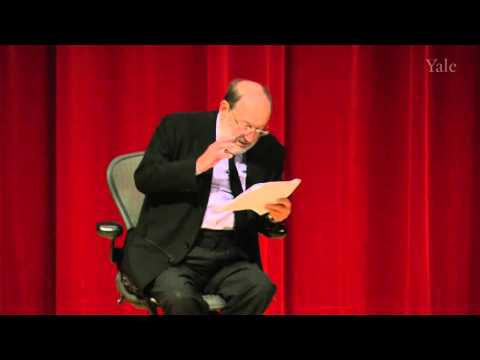
I used AI to help turn the automatic captions into a reading copy. That meant repairing broken sentences while keeping Eco’s spoken English, grouping the talk into paragraphs and chapters, and setting the passages he reads aloud apart from his own argument. A contents list gives readers somewhere to start; the timestamps let them hear the delivery or check the wording without hunting through the video.
The references needed a different kind of work. AI can suggest where a half-heard name or an allusion comes from. A suggestion still needs checking against the audio, the work Eco is citing, or his writing on the same subject. The short notes belong beside the text, not in Eco’s voice. Where the recording and sources don’t settle a word, leaving it marked as unclear is more useful than making it up.
This makes the lecture searchable and usable without sound. It also gives readers who don’t already know Eco’s references a way into the argument without asking everyone to stop for the same explanation. There’s a connection to the lecture itself: a library keeps things available for rediscovery. A good reading edition does something similar. It gives us more ways to find a passage and still lets us get back to the source.
The Library as Labyrinth
Applause
0:07Good evening — as it was said by the Pope recently. Well, I hope that the Beinecke people will not be upset if I start with a homage to the Sterling Library. It was there that I got the first idea of the library I imagined for my novel The Name of the Rose.
0:42It happened when I was exploring one of the mezzanines, which you could not reach by the elevator and were pretty somber and funereal. At a certain moment I felt lost, unable to find a way out, and at that moment I had the vivid impression that if I had killed somebody and put the corpse somewhere under the shelves, 1:07 it would have taken a lot of time before it was discovered.
Starting from such a peaceful and gentle picture, I started designing in my mind my own library as a labyrinth, keeping in mind that, according to a medieval definition, labyrinthus — that is, a labyrinth — is a model of the world.
1:34But if the labyrinth is an image of our world, and a library is a labyrinth, then by a transitive property a library is an image, a model, and then an ersatz of our world.
Bookish Echoes and Pavel’s Angels
1:48But since our world, such as we know it, is the one depicted by our culture, a library is the equivalent of our culture, insofar as culture, in the anthropological sense of the term, is a system of ideas, data, values, habits and traditions that all the members of a given group share — so that there existed a Greek culture of the age of Pericles, as well as there exists a Bantu culture.
2:23If you run deliriously through a library, you can be peopled by an ungodly multitude of bookish echoes of your previous cultural experience:
Abraham begat Isaac, and Isaac begat Jacob, and Jacob begat the Man of La Mancha. And that was when I saw the Pendulum, on that branch of Lake Como where late the sweet birds sang, the snows of yesteryear softly falling into the dark mutinous Shannon waves. Time, by any other name, is out of joint.
3:00The women come and go. A kiss is just a kiss, and a rose is a rose is a rose, tu quoque, alea. A man without qualities should ask what he can do for his country. Beauty is truth, truth beauty, too many rings around Rosie, because happy families are all alike. De la musique avant toute chose, go where the lemon blossoms.
3:22Once upon a time, the earth was without form. Licht, mehr Licht, über alles. What is life? Names, names, names: Julien Sorel, [unclear], Disraeli, Jurassic Park, Madame de Pompadour, Smith & Wesson, Rosa Luxemburg, [unclear], Matthew, Mark, Luke, John, Pinocchio, Justine, Thaïs the whore with the shitty fingernails, osteoporosis, [unclear], Alexander and the Gordian knot. That is all ye know on earth, and all ye need to know.
The book of the angels
4:06And once Thomas Pavel, a colleague of mine, invited us to try a fascinating mental experiment. Let’s suppose that an omniscient being is capable of writing or reading a magnum opus that contains all the true assertions regarding both the real world and all possible 4:29 worlds. Naturally, since we speak of the universe using different languages, and since each language defines the world in a different way, there exists a maximal collection, or total image, of magna opera.
4:44Let’s now suppose that God charges a number of angels with writing daily books for each individual human being. In them they take note of all the propositions concerning the possible worlds of that individual’s desires and hopes, and the real world of his acts, that correspond to a true statement in one of the books that make up the maximal collection of magna opera.
5:10The collection of daily books belonging to a given individual must be produced on the Day of Judgment, along with the collection of books concerning families, tribes and nations. But the benevolent angels who write the daily books are not content to align true statements. They connect them, evaluate them and build them into a system. And since on the Day of Judgment individuals and groups will each have a defending angel, 5:40 the defenders will rewrite for each individual an astronomical series of daily books, in which the same statements will be linked together in a different way, and differently compared to the affirmations of some of the magna opera.
Since infinite alternative worlds make up each of the infinite magna opera, 6:01 the angels will write an infinite number of daily books in which affirmations that are true in one world and false in another will be mingled together. If we further hypothesize that some of the angels may be clumsy and mix up affirmations registered as mutually contradictory by a single magnum opus, 6:25 what we will end up with will be a series of compendia, miscellanea, florilegia — fragments of miscellanies that amalgamate strata of books of different origins.
At that point it will be very difficult to say which books are truthful and which fictional, and with respect to what original. We will have an astronomical infinity of books, each of which straddles different worlds, and we will no doubt consider as true stories that others have considered as fictional.
7:02This gives us a good idea of what a maximal encyclopedia might look like, if we substitute for the angels all the human beings who left behind their traces, from the bisons of Altamira to the invention of writing, and beyond.
7:25Pavel’s narrative gives a reasonable representation of our situation when confronted by the universe of affirmations that we are accustomed to accept — not as true, but in any case as once expressed. Is the picture provided by Pavel an image of the culture we live in? Happily, 7:53 not. Confronted with the virtual immensity of the maximal encyclopedia, which is a regulative hypothesis, we usually attempt to reduce its format, to construct local representations with the purpose of understanding a single context. This means that culture is not only a way of storing our memories, but also a way to filter them.
The Standard and the Maximal Encyclopedia
8:33Speaking of the meaning of a given term, we usually refer to a standard set of notions on the basis of which both a layperson and a naturalist can agree on the properties evoked by the term mouse, both understanding in the same way the sentence “there is a mouse in the kitchen.” But for the same word mouse there is also a specialized knowledge shared only by naturalists.
9:04So on the one hand there is a standard encyclopedia, shared in the present case both by the naturalist and by the common native speaker, and on the other an unmanageable plurality of specialized encyclopedias, the complete collection of which would constitute the unattainable maximal encyclopedia of which Pavel was speaking.
9:40Accordingly, we could imagine this stratification — or what Hilary Putnam has called the social division of linguistic labor — by thinking of a kind of solar system: the maximal encyclopedia, in which a great many specialized encyclopedias describe orbits of varying circumference around the central nucleus, the standard encyclopedia. So it could happen that the works of Plato, except for the Timaeus, were not part of the standard encyclopedia of medieval culture, 10:19 while the idea that the Ptolemaic system was believed to be true in the past, whereas today it is considered erroneous, is still part of our current Western encyclopedia, 10:33 without it being forgotten.
To sum up, we might say that the official standard encyclopedia of our present Western culture is represented by the 32 volumes of the Britannica, while single members of our culture share only a part of it, according to the format of the education they received — so that a mid-cultivated person masters more or less a mid-size, one-volume encyclopedia of general information. It happens with the format of one’s encyclopedic information 11:16 what happens with the difference between the number of words mastered by a newly immigrated taxi driver and by a university professor.
Besides, once I met in Florence an official of a Washington agency who, while tasting a delicious fish from the Italian coast, asked whether the Mediterranean was a salt or a freshwater lake. I obviously answered that it was salt, adding that in fact it was bigger than Philadelphia.
11:51In fact, not all the contents of a standard encyclopedia are shared by all the members of a given culture. A cultivated person may have forgotten, or never have known, the date of Napoleon’s death, but knows where that information is accessible. An educated person is not someone who knows the dates of the beginning and the end of the Seven Years’ War, but someone who can come up with them in a short time.
Memory, Mnemonics and the Art of Forgetting
12:24The standard encyclopedia cannot be identified with an extensive library containing thousands, even millions of volumes. Such a library, though it may not be commensurate with the maximal encyclopedia, nevertheless encompasses the standard encyclopedias of exotic cultures and of past civilizations, and ideally all of the specialized encyclopedias, past and present. Say that the Sterling is such a kind of encyclopedia. 13:04 The Beinecke is instead a patchwork of specialized encyclopedias of different ages and cultures.
Not just the maximal encyclopedia, but even the parody of it represented by a normal library, should provoke the vertigo of a knowledge so exaggeratedly extensive that nobody could ever capture or contain it in their own individual memory. This leads us to the problem of memory and forgetfulness — 13:38 the problem, in other words, of the vertigo of the labyrinth.
Palaces of memory
Since classical antiquity, the problem of the need to forget appears contemporaneously with the development of mnemonic techniques by which to commit to memory the maximum amount of information — especially in the centuries in which information was not as readily obtainable and transportable as it became with the invention of printing, and subsequently of electronic devices.
14:16So a scholar had to go around with techniques able to make him remember the encyclopedia he did not have in his hands. The classical example of mnemotechnics, of which you can find many instances here in the Mellon Collection, is based on the imaginary construction, and sometimes the designed construction, of a complex spatial image: a palace, a square, a city, where there are architectural items or statues, many representing strange or terrifying facts, to which one could associate every kind of data: concepts, logical principles, events, and so on, 15:10 so that, by figuring out or visiting the place and remembering these images, one could remember a complete system of notions.
Sometimes it was more difficult to remember the mnemonic images than the data to be retrieved. And one of the terrors of the practitioners of mnemonics was that of remembering so much as to confound all their ideas and, as a result, forget practically everything.
15:44It seems, in fact, that at a certain point in his life Giulio Camillo, who constructed a big theater of memory — maybe you have read about it in the books of Frances Yates — had to excuse himself for his confused state and for the gaps in his memory, citing as an explanation his protracted and frantic application to his theater of memory.
16:16On the other hand, in his polemic against the arts of memory, Cornelius Agrippa, in De vanitate scientiarum, claimed that the mind is rendered obtuse by those monstrous images and, being so overburdened, is led to madness. Hence, parallel to the fortunes of the ars memoriae, the reappearance from time to time of the phantasm of an ars oblivionalis, an art of forgetting.
Themistocles’ wish
16:53In the De oratore, for example, Cicero cites the case of Themistocles, who was gifted with an extraordinary memory. When someone offered to teach him a mnemotechnique, Themistocles replied that his interlocutor would be doing him a greater kindness 17:17 if he taught him how to forget what he wished to forget than if he taught him how to remember — inasmuch as he would prefer to be able to forget something he didn’t wish to remember than to remember everything he had once heard or seen.
So, in lesson 20 of his Plutosofia (1592), Filippo Gesualdo reviewed many methods for oblivion. 17:50 Gesualdo is aware that Johannes Spangenbergius, in his Libellus artificiosae memoriae, reminded his readers that people forget from corruption — that is, from forgetfulness of past species — by diminution, old age and sickness, and from ablation of cerebral organs. Likewise, it is obvious that we can forget through drunkenness and drugs. But that was not the problem of Filippo Gesualdo.
18:22His intent was to develop an art of forgetting that employed the same techniques as an art of remembering. And so he advised:
First, having recited, and wishing to consign the images to oblivion, either in the daytime with closed eyes or at night in darkness, you should go wandering with your mind through all the imagined places, evoking an obscure nocturnal gloom that hides all the places. And proceeding in this fashion, and going back a number of times with the mind and not seeing any image, every figure will soon disappear. Go peering into all the places with the mind, back and forth, and contemplate them empty and bare, as they were formed for the first time, without any images in them. And this operation should be performed several times.
Just as the painter passes over and whitewashes his paintings to cancel them, so we too can cancel the images with colors painted over them — and these colors are white, green or black — imagining over the places white curtains, green sheets or black cloths, and going over the places a number of times with these veils of colors. And one can also imagine the places stuffed with straw, hay, firewood, merchandise, etc.
19:51I consider it an excellent rule to put new figures in a place, because just as one nail drives out another, so forming new images and putting them in the places already imagined cancels the first images from our memory. 20:06 It is true that it is necessary to imprint them with great care and mental effort, and to repeat them frequently in the darkness and in the quiet of the night, so that the intense and vivid idea of the second ones drives out the first ideas.
Or imagine a great storm of winds and hail that ruins the buildings and places and temples. A flood then leaves everything in a state of confusion. 20:35 And when this new thought has continued for a while and been repeated several times, finally go walking among the places with your mind, imagining the weather bright and calm and peaceful, and seeing the places empty and bare as they were formed for the first time.
And imagine a man, hostile, terrible and fearsome, who with a troop of armored companions enters and passes impetuously among the places, and with scourges, staves and other weapons drives out the likenesses, assaults the people, shatters 21:12 the images, puts to flight through doors and windows all the animals and animated persons who were in the places, until, after the tumult has passed, in the ruin — 21:24 seeing the places with a mind recovered from its terror, they will be seen bare and vacant as before. And if this destruction were to occur at the hands of hostile armies, such as the Turks and pagans, it would be even more effective, because that terror confounds things and sets everything upside down.
Those are the rules for forgetting. Try it tonight at home and see what happens.
Why forgetting cannot be willed
21:56We don’t know whether anyone ever put into practice the artifice Gesualdo recommended. But we are entitled to suspect that all those stratagems made it possible not to forget, but to remember better what one wanted to forget, and to remember it with greater intensity — as occurs when lovers try to blot out 22:29 the image of the person who has abandoned them, and the more they cancel it, the more vividly the countenance of the beloved resurfaces. I think it is a common experience.
The psychological and physiological reasons why an ars oblivionalis is impossible depend on the contiguity–similarity dialectic on which the classical mnemonic systems are founded. 23:02 If an object X has been imagined to be in contact with an object Y, or if an object X is in some way homologous or similar to the object Y, every time the object X is evoked, so is the object Y.
Culture as a Filter
23:21But if this is how the arts of memory work, it is hard to see how one can imagine an object X that, when evoked, somehow acts on our cerebral cortex by cancelling Y. How, then, to forget undesirable information? We already encountered the problem in Themistocles, through Cicero. But the dread of excess certainly increases with the invention of printing, which not only makes available an enormous quantity of textual material, but also facilitates access to it for the man in the street, and leads from the primacy of remembrance to the primacy of forgetting.
24:17Thus we witness the development of an art not unknown in the centuries of manuscript culture, but which acquires central importance in the culture of print: the ars excerpendi, that is, the art of compiling abstracts and summaries so as to retain only the knowledge we judge indispensable, and to let marginal information fall by the wayside.
Nietzsche’s alarm
24:51In any case, what we may call the Themistocles complex returns over and over again in the course of cultural history. One of its most dramatic manifestations is surely the second of Nietzsche’s Untimely Meditations, which deals with the advantages and disadvantages of historical studies for life. Nietzsche wrote about “the capacity to sense things unhistorically”:
25:33The person who cannot set himself down on the crest of the moment, forgetting everything from the past, who is not capable of standing on a single point, like a goddess of victory, without dizziness or fear, will never know what happiness is. Even worse, he will never do anything to make other people happy.
25:59Imagine the most extreme example, a person who did not possess the power of forgetting at all, who would be condemned to see everywhere a coming into being. Such a person no longer believes in his own being, no longer believes in himself, sees everything in moving points flowing out of each other, and loses himself in this stream of becoming. Like the true pupil of Heraclitus, he will finally hardly dare any more to lift his finger.
26:36Forgetting belongs to all action, just as both light and darkness belong in the life of all organic things. A person who wanted to feel utterly and only historically would be like someone who was forced to abstain from sleep, or like the beast that is to continue its life only from rumination to constantly repeated rumination.
27:03For this reason, if it is possible to live almost without remembering, it is generally completely impossible to live without forgetting. Or, to explain myself more clearly concerning my thesis: there is a degree of insomnia, of rumination, of the historical sense, through which living comes to harm and finally is destroyed, whether it is a person or a people or a culture.
27:35This is, for Nietzsche in his meditation, the starting point for an analysis of the negative effects of the excess of historical studies, which in his times had reached such an unbearable complexity and richness as to oppress the memory of a culture. And now comes the call for youth to develop an art of forgetfulness.
28:10One of the interesting things about this text is that, while these remarks seem to address the individual’s need for survival, the emphasis changes to the need for a systematic forgetting on the part of a culture. 28:29 In general, this switch is of capital importance. Once the impossibility of voluntarily forgetting what the individual memory has recorded has been demonstrated, cultures present themselves as systems that function not only to preserve and hand down information useful to survival, but also to cancel the information judged to be in excess.
29:02A culture is surely a device for storing, preserving and collecting memory, a system of data and values, and when all this treasury of information is lost, that culture collapses and disappears. But a culture is at the same time a device for limiting an excess of information. A culture as historical memory is not only a stack of data; it is also the result of their percolation. 29:37 It represents our ability in throwing away everything we do not consider useful or necessary.
The history of a civilization is made up of millions of data which have been buried. Frequently we have discovered that such a process was a loss, and we needed centuries to retrieve lost information. Our Greek ancestors had forgotten Egyptian mathematics, and the Middle Ages had forgotten a great part of Greek science. 30:11 Likewise, we have by now forgotten the meaning of the statues of Easter Island, and many of the tragedies quoted by Aristotle in his Poetics are definitively lost. However, in spite of these undesirable accidents, a culture must eliminate a lot of information. By the way, this process of cancellation not only holds for cultures, but also for our personal life.
Funes the Memorious
30:42Jorge Luis Borges, who certainly had read the pages of Nietzsche, wrote, as you probably know, a beautiful story, “Funes el memorioso,” on a character, Funes, who remembers every leaf he saw in his childhood, every word he heard in the course of his life, every murmur of wind he felt on his skin, every sentence he read. Just because of such total memory, 31:18 Funes was an idiot, paralyzed by his inability to filter and to throw away the results of his experiences.
Our unconscious works because it removes [i.e. represses]. If then something disturbs us, we ask our psychoanalyst to retrieve what we removed because it was too embarrassing — but it was important to eliminate all the rest, and our soul is the product of such a selective memory.
31:49If we had the fullness of memory, we would be animals without soul, that is, without identity. Our identity is made not only by what we remember but also by what we succeeded in forgetting. However, a culture frequently doesn’t only make individuals forget what they know or knew. It also keeps them from finding out what they do not know.
What a Culture Cancels
32:24Yet a century and a half after Nietzsche’s text, reflection on cultural forgetting has intensified, without renewing the provocation of Nietzsche’s cry of alarm. The process of cancellation continuously performed by a culture simply in order to stay alive today appears normal.
32:52Identifying memory and culture, today we study the forgetting that culture mobilizes through various kinds of cancellation. These can range from censorship, the erasure of manuscripts, bonfires of books, damnatio memoriae, forgery of documentary sources and negationism, to forgetfulness out of shame, inertia or remorse — down to those processes current in the exact sciences in which it is decided that not only the hypotheses proven erroneous, but even the efforts and procedures followed to arrive at 33:35 the correct ones, are expunged from the specialized encyclopedia of a particular science, because it is believed that they are no longer useful.
This provokes terrifying holes in the scientific bibliographies. Such a loss of memory is disastrous for a culture. But today, if not in the humanities, at least in the hard sciences, things go this way, and in many scientific essays you cannot find bibliographical data older than ten years, as I was saying yesterday.
34:17This happens even in the humanities. Once I found a philosophical text suggesting that a given idea was already present in Kant, and the footnote read: “Cf. Brown 1998.” If the specialized encyclopedias are subject to the process of forgetting, so much more so is the standard encyclopedia of a given culture.
Calpurnia and Jean Dupont
34:44It guarantees remembrance of the important historical facts or of the principles of physics, but it omits an infinite amount of information that the collectivity has repressed because it decided it was neither useful nor pertinent. Our standard encyclopedia provides precious details about the progress of the Battle of Waterloo, but it doesn’t give us the names of all the participants, including obviously the 50,000 casualties.
35:24It tells us all we need to know about the death of Julius Caesar, but nothing about what his widow Calpurnia did after the assassination of her husband. This is not a case of male chauvinism, because the same encyclopedia records everything that happened to Clara Schumann after the death of Robert, since Clara continued her career as a distinguished pianist and presumably had a tortured love affair with Brahms.
36:00It simply means that the fate of poor Calpurnia was not relevant for the history of our civilization — as well as the fact that at Waterloo a given Jean Dupont died instead of a John Smith. It was useful to forget these data so as not to overload the collective memory more than it can bear, and without rendering the filtered facts irretrievable, 36:33 since there do exist specialized individuals — let’s say historians or archaeologists — capable of bringing them to light.
In such cases, the collective memory sometimes picks up on the data, restoring them to the standard encyclopedia, and sometimes decides instead to leave them inside specialized Indian reservations. The filtering performed by the standard encyclopedia doesn’t depend on the will of an individual or on a conscious act of collective will. 37:13 It occurs out of a kind of inertia, sometimes even from natural causes, like the cancellation of precise information regarding Atlantis — if it ever existed.
Vincent of Beauvais
The problem of filtering by the standard encyclopedia was in any case already present among the medieval encyclopedists. 37:38 They seem to us to be intent on handing on everything that tradition had handed on to them. Yet in the Libellus apologeticus that serves as an introduction to his Speculum maius, Vincent of Beauvais is already shocked by the proliferation of knowledge. This is why he decides to make his encyclopedia a florilegium — in other words, a selection of the best of his readings.
Not to be suspected of censorship, 38:16 Vincent quotes the so-called Decretum Gelasianum, a compendium of what was either apocryphal or canonical in the Holy Scripture. And Vincent decides to quote also forbidden books, so that his readers could make a distinction between true and false texts and decide what to trust and what to forget. But in this sense, certain texts survived only because Vincent included them in his Speculum maius, even though he included them as wrong texts.
Latency and Recovery
39:01All a culture does, then, is to select the data for its own memory. It may not do what Stalin did when he erased from historical photographs the faces of the comrades he had sent to death, or what Orwell’s Big Brother did when he corrected the news in the Times every morning.
39:24But when we read that some English schools proposed to abolish the teaching of the Crusades so as not to offend the sensibilities of their Muslim students, it becomes apparent that culture is a continual process of rewriting and selecting information. What distinguishes a big library like the Beinecke from that of a high school, or from the personal one of an educated but not specialized person?
The lost tragedies
40:00I said that if we read Aristotle’s Poetics, we find the mention of many tragedies which have not survived until our times. We do not know why these tragedies got lost, nor the names of their authors. A naive hypothesis is that Sophocles, Aeschylus and Euripides survived because they were the best ones. But according to which criterion, for which inscrutable reasons, were they selected and did they enter the canon?
40:41Maybe marvelous lost tragedies were censored. Maybe, by corruption and bribery, the Athenian authorities ordered that Sophocles be performed more frequently than some of his unfortunate companions. How to repair these unpleasant accidents? Cultures — at least our Western culture, philologically oriented cultures — are concerned with the possibility of retrieving data whose loss we consider a disgrace.
41:21That is why we need the work of specialists, supposed to resurrect notions and experiences which by accident sank into the dark. In doing this, the collective memory is able to re-emerge these data and put them again in the standard encyclopedia or in some specialized one.
The deep freeze
41:47It is why a major culture decides to put some information in a state of latency. Exceeding information is, or was, so to speak, deep-frozen, so that when it is necessary, experts can put it in an ideal microwave oven to retrieve it again — 42:11 for instance, in order to thaw an old, newly discovered document. The places of latency are represented by the model of the library or the archive, as the indispensable containers of a wisdom that can be revisited even though it was not revisited for centuries.
42:33Naturally, there are cases of very deep latency, in the sense that something had been really forgotten and ignored for centuries, and no library was able to store it, and it is sometimes rediscovered by chance — like the Riace bronzes, which for centuries were buried in the deep sea, or the Dead Sea Scrolls, or the Nag Hammadi manuscripts. 43:02 In this case, a culture must revise and rewrite its files, and then enrich either its specialized encyclopedias or the standard one, or both.
No encyclopedia, no library keeps note of all the soldiers who took part in the Battle of Waterloo. On the contrary, we have the complete list of the Thousand — the Garibaldini — who went with Garibaldi to conquer Sicily. 43:32 We have all the names, but they were fewer than the fighters at Waterloo. Let’s now suppose that a scholar succeeds in putting his hands on an as-yet-unknown archive and finds these names [of the Waterloo soldiers].
43:50I do not know how useful it can be to have all those names, but we could then move these data from an inaccessible maximal encyclopedia and insert them into a hyper-specialized one. And perhaps that list could be hosted by the Sterling Library — or, if written on a 19th-century manuscript, by the Beinecke — to which encyclopedia it would belong.
The accordion
44:20As for the texts of the lost tragedies mentioned by Aristotle: until now, a specialized literary encyclopedia can simply record the datum that of these texts we know only the titles. What will happen if these texts are never retrieved?
For the very fact that there are good reasons to believe that they once existed — 44:49 if Aristotle was not a damned liar — we will keep going on thinking that they could belong to the maximal encyclopedia, the one described by Pavel with his story of angels, even though they belong to it only virtually and in an optative way.
Thus the maximal encyclopedia — if the term only lets us think of something quo nihil maius cogitari possit, something than which nothing greater can be thought, like the God of Anselm of Aosta — is a structure, virtually accordion-like, which can one day or another be stretched in infinitum. Which is not a little encouragement for the advancement of learning, and the permanent hope for a great library ready to embrace in its womb even the wisdom of tomorrow.
A note on the text
This is a corrected transcript of Umberto Eco’s lecture “The Library as a Model for Culture: Preserving, Filtering, Deleting and Recovering,” given on 18 October 2013 at the Yale University Art Gallery for the fiftieth anniversary of the Beinecke Rare Book & Manuscript Library. Yale posted the recording on YouTube on 30 October 2013.
The text was worked out from the auto-generated captions, from the sources Eco cites, and from his published writing on the same material: “An Ars Oblivionalis? Forget It!” (PMLA, 1988), the essay on forgetting in Dall’albero al labirinto (2007), and the opening of The Mysterious Flame of Queen Loana (2004), from which the litany of literary echoes comes. Doubtful passages were then checked against the recording.
- Times in the margin mark where a paragraph begins in the recording; the small figures inside the text mark where the speech continues. Each opens the video at that moment.
- Annotated phrases open notes beside the text. The editorial notes below also link back to their passages and, where available, to references for further reading.
- Eco’s spoken English is kept. Grammar is mended only where the captions broke a sentence.
- [unclear] marks words that could not be recovered. Other square brackets are editorial.
- Passages Eco reads aloud (Gesualdo, Nietzsche) are set apart, as he read them. Spoken cues that repeat the layout are omitted. Chapter titles and subheadings are editorial. The host’s closing remarks are omitted.
Editorial correction at 34:17: the name previously marked unclear is Kant.
Editorial notes
-
Ersatz
A substitute or stand-in, from the German word for replacement. Here the library stands in for the world: the world itself is not on the shelves, but descriptions and interpretations of it are.
Back to passage -
Compendia, miscellanea, florilegia
Compendia condense a body of material; miscellanea collect varied pieces; florilegia gather selected passages from other works. Eco is imagining books assembled out of pieces that came from different accounts of the world.
Back to passage -
Optative
Expressing a wish or hope. Eco means that the lost plays have a place in the imagined complete library, even though there is no surviving text to put on a shelf.
Back to passage -
Pope Francis’s “Buonasera”
On the evening of his election, 13 March 2013, Pope Francis greeted the crowd in St Peter’s Square with a plain “Buonasera” — “Good evening.” Eco borrows the greeting seven months later.
Reference: Pope Francis’s “Buonasera” Back to passage -
Beinecke Rare Book & Manuscript Library
Yale’s rare book library, opened in 1963 and designed by Gordon Bunshaft. Its walls of thin translucent marble let filtered daylight in on the books. Eco’s lecture marked its fiftieth anniversary.
Reference: Beinecke Rare Book & Manuscript Library Back to passage -
Sterling Memorial Library
Yale’s main library, finished in 1930 in Collegiate Gothic style and laid out like a cathedral. Eco credits its stacks with the first idea for the abbey library of The Name of the Rose.
Reference: Sterling Memorial Library Back to passage -
The Name of the Rose (1980)
Eco’s first novel: a murder mystery in a 14th-century abbey whose library is a labyrinth guarded by the blind monk Jorge of Burgos. The plot turns on a lost book, the second part of Aristotle’s Poetics, on comedy.
Reference: The Name of the Rose (1980) Back to passage -
The labyrinth as world
Medieval writers and builders used the labyrinth as an emblem of the world and of the soul’s winding path through it. The best-known example is the pavement labyrinth laid in Chartres Cathedral in the early 13th century.
Reference: The labyrinth as world Back to passage -
The litany of echoes
What follows is, with small variations, the opening of Eco’s novel The Mysterious Flame of Queen Loana (2004): an antiquarian bookseller wakes from a stroke remembering nothing of his own life, only the lines of everything he has read. Each line below has its own note.
Reference: The litany of echoes Back to passage -
Matthew meets Cervantes
The genealogy that opens Matthew’s Gospel (“Abraham begat Isaac…”) swerves into Cervantes: Don Quixote is the man of La Mancha.
Reference: Matthew meets Cervantes Back to passage -
Foucault’s Pendulum (1988)
The first line of Eco’s own second novel: “That was when I saw the Pendulum.”
Reference: Foucault’s Pendulum (1988) Back to passage -
Manzoni, The Betrothed
The famous opening of Alessandro Manzoni’s I promessi sposi (1827), every Italian schoolchild’s first sentence of the national novel.
Reference: Manzoni, The Betrothed Back to passage -
Shakespeare, Sonnet 73
“Bare ruin’d choirs, where late the sweet birds sang.”
Reference: Shakespeare, Sonnet 73 Back to passage -
Villon, “Ballade des dames du temps jadis”
Rossetti’s English for Villon’s refrain, “Mais où sont les neiges d’antan?” — “But where are the snows of yesteryear?”
Reference: Villon, “Ballade des dames du temps jadis” Back to passage -
Joyce, “The Dead” (1914)
From the last paragraph of the closing story of Dubliners, as snow falls over all of Ireland.
Reference: Joyce, “The Dead” (1914) Back to passage -
Shakespeare, twice over
Hamlet’s “The time is out of joint” (act 1, scene 5), crossed with Juliet’s “a rose by any other name.”
Reference: Shakespeare, twice over Back to passage -
Eliot, “Prufrock” (1915)
“In the room the women come and go / Talking of Michelangelo.”
Reference: Eliot, “Prufrock” (1915) Back to passage -
“As Time Goes By”
The song made famous by Casablanca (1942), a film Eco analysed in his essay “Casablanca: Cult Movies and Intertextual Collage.”
Reference: “As Time Goes By” Back to passage -
Gertrude Stein
From her poem “Sacred Emily” (1913).
Reference: Gertrude Stein Back to passage -
Two Caesars in one breath
“Tu quoque, Brute?” (“You too, Brutus?”), the words tradition puts in Caesar’s mouth at his murder, and “Alea iacta est” (“The die is cast”), said as he crossed the Rubicon.
Reference: Two Caesars in one breath Back to passage -
Musil meets Kennedy
Robert Musil’s unfinished novel The Man Without Qualities (1930–43), run into John F. Kennedy’s 1961 inaugural address: “ask what you can do for your country.”
Reference: Musil meets Kennedy Back to passage -
Keats, “Ode on a Grecian Urn” (1819)
The ode’s famous ending, whose last words also close this litany: “that is all / Ye know on earth, and all ye need to know.”
Reference: Keats, “Ode on a Grecian Urn” (1819) Back to passage -
“Too Many Rings Around Rosie”
A song from the 1925 musical No, No, Nanette, with an echo of the nursery rhyme “Ring a Ring o’ Roses.”
Reference: “Too Many Rings Around Rosie” Back to passage -
Tolstoy, Anna Karenina (1878)
“Happy families are all alike; every unhappy family is unhappy in its own way.” The novel’s first sentence.
Reference: Tolstoy, Anna Karenina (1878) Back to passage -
Verlaine, “Art poétique”
“Music before everything else”: the first line of Paul Verlaine’s poem on poetry, written in 1874.
Reference: Verlaine, “Art poétique” Back to passage -
Goethe’s Mignon
The song in Wilhelm Meister’s Apprenticeship: “Kennst du das Land, wo die Zitronen blühn?” — “Do you know the land where the lemon trees bloom?”
Reference: Goethe’s Mignon Back to passage -
Genesis 1:2
“And the earth was without form, and void,” in the King James Version.
Reference: Genesis 1:2 Back to passage -
German, twice over
“Light, more light!”, Goethe’s reputed last words (1832), joined to “über alles” from the first line of the Deutschlandlied.
Reference: German, twice over Back to passage -
Julien Sorel
The ambitious young hero of Stendhal’s The Red and the Black (1830).
Reference: Julien Sorel Back to passage -
Dante, Inferno XVIII
Among the flatterers, plunged in excrement, Dante meets Thaïs the courtesan scratching herself with her “unghie merdose” — her filthy nails.
Reference: Dante, Inferno XVIII Back to passage -
Thomas Pavel
Romanian-born literary theorist, long at the University of Chicago, whose Fictional Worlds (1986) brought possible-worlds logic into the study of fiction — territory he shared with Eco.
Reference: Thomas Pavel Back to passage -
Magna opera
Plural of magnum opus, “great work.”
Back to passage -
Eco’s encyclopedia
A key term of Eco’s semiotics, set out in Semiotics and the Philosophy of Language (1984). Meaning is not a dictionary of fixed definitions but an open, labyrinthine network of everything a culture has recorded about a term. The maximal encyclopedia is that network in its unreachable totality.
Back to passage -
Cave of Altamira
Upper Palaeolithic paintings in a cave in northern Spain, found in 1879 and famous for their polychrome bison.
Reference: Cave of Altamira Back to passage -
Regulative idea
Kant’s term for an idea that can never be realized in experience but still guides inquiry, such as the totality of all knowledge. For Eco the complete encyclopedia is one: no one can possess it, yet every act of interpretation presupposes it.
Back to passage -
The division of linguistic labor
In “The Meaning of ‘Meaning’” (1975), Hilary Putnam argued that ordinary speakers use words like gold or elm while leaving to experts the job of telling the real thing from look-alikes.
Reference: The division of linguistic labor Back to passage -
Plato in the Middle Ages
For most of the Middle Ages the Timaeus, in Calcidius’s partial Latin translation, was the only dialogue of Plato widely read in the Latin West.
Reference: Plato in the Middle Ages Back to passage -
The Ptolemaic system
The geocentric cosmos systematized by Ptolemy in the 2nd century AD, displaced after Copernicus.
Reference: The Ptolemaic system Back to passage -
Encyclopædia Britannica
The 15th edition ran to 32 volumes. Britannica announced the end of its print edition in 2012, the year before this lecture.
Reference: Encyclopædia Britannica Back to passage -
For the record
5 May 1821, in exile on Saint Helena.
Reference: For the record Back to passage -
The art of memory
The classical method of loci: learn a building by heart, set a vivid image for each thing to remember in its rooms, then walk through it in the mind to recall them. Ancient rhetoric traced it to the poet Simonides.
Reference: The art of memory Back to passage -
The Mellon Collection
Paul Mellon’s collection of alchemical and occult books and manuscripts, given to Yale and kept at the Beinecke.
Back to passage -
Giulio Camillo (c. 1480–1544)
He spent years building a wooden “theater of memory” meant to hold all knowledge, and showed it to the King of France. His L’idea del theatro appeared after his death, in 1550.
Reference: Giulio Camillo (c. 1480–1544) Back to passage -
Frances Yates
Historian of the Renaissance whose The Art of Memory (1966) revived interest in Camillo, Giordano Bruno and the memory palaces.
Reference: Frances Yates Back to passage -
Heinrich Cornelius Agrippa (1486–1535)
Occult philosopher who, in De incertitudine et vanitate scientiarum (1530), turned on the learning of his day, the art of memory included.
Reference: Heinrich Cornelius Agrippa (1486–1535) Back to passage -
Ars oblivionalis
An “art of forgetting,” the mirror of the art of memory. In “An Ars Oblivionalis? Forget It!” (PMLA, 1988) Eco argued that it cannot exist: any sign used to cancel a memory only calls it back to mind.
Back to passage -
Cicero, De oratore II.299
Offered the art of memory, Themistocles answers that he would rather learn the art of forgetting: he remembers what he would rather not, and cannot forget what he would like to.
Reference: Cicero, De oratore II.299 Back to passage -
Filippo Gesualdo
Franciscan friar, later head of his order, whose Plutosofia (Padua, 1592) is a handbook of the art of memory.
Back to passage -
Johann Spangenberg (1484–1550)
German Lutheran preacher and author of schoolbooks; his Libellus artificiosae memoriae is a short manual of mnemonics.
Reference: Johann Spangenberg (1484–1550) Back to passage -
Contiguity and similarity
The two classic laws of association: we recall things together because they were next to each other, or because they resemble each other. Roman Jakobson mapped the same pair onto metonymy and metaphor.
Reference: Contiguity and similarity Back to passage -
Ars excerpendi
The early-modern craft of excerpting and note-taking — commonplace books, florilegia, indexes — developed to cope with the flood of printed books.
Reference: Ars excerpendi Back to passage -
Untimely Meditations
Nietzsche’s four essays of 1873–76. The second, “On the Advantage and Disadvantage of History for Life” (1874), attacks the historical culture of his day.
Reference: Untimely Meditations Back to passage -
Heraclitus
Greek philosopher of perpetual flux (c. 500 BC): everything flows, and you cannot step into the same river twice.
Reference: Heraclitus Back to passage -
Aristotle’s Poetics
His treatise on tragedy (c. 335 BC) cites plays now lost, such as Agathon’s Antheus, whose plot and characters were wholly invented.
Reference: Aristotle’s Poetics Back to passage -
“Funes the Memorious” (1942)
Borges’s story of Ireneo Funes, who after a fall from a horse remembers everything he has ever perceived, and is crushed by it.
Reference: “Funes the Memorious” (1942) Back to passage -
Damnatio memoriae
“Condemnation of memory”: the Roman practice of erasing a disgraced person’s name and face from inscriptions, coins and images.
Reference: Damnatio memoriae Back to passage -
Negationism
Distorting or denying the historical record, as in Holocaust denial.
Reference: Negationism Back to passage -
Calpurnia
Caesar’s third wife, who in the tradition dreamed of his death on the eve of the Ides of March, 44 BC. Little is known of her afterward.
Reference: Calpurnia Back to passage -
Clara Schumann (1819–1896)
Pianist and composer. After Robert Schumann’s death in 1856 she toured for decades; her close bond with the young Brahms is famous, its exact nature unknown.
Reference: Clara Schumann (1819–1896) Back to passage -
Atlantis
The island Plato describes in the Timaeus and Critias, swallowed by the sea in a single day and night.
Reference: Atlantis Back to passage -
Vincent of Beauvais (c. 1190–c. 1264)
Dominican friar whose Speculum maius (“Great Mirror”) was the largest encyclopedia of the Middle Ages.
Reference: Vincent of Beauvais (c. 1190–c. 1264) Back to passage -
Florilegium
“A gathering of flowers”: an anthology of excerpts.
Reference: Florilegium Back to passage -
Decretum Gelasianum
A list of books to be received and books to be rejected, attributed to Pope Gelasius I but probably compiled in the 6th century.
Reference: Decretum Gelasianum Back to passage -
Retouched history
Soviet retouchers removed purged officials from official photographs — most famously Nikolai Yezhov, who vanished from a picture beside Stalin on the Moscow Canal.
Reference: Retouched history Back to passage -
Nineteen Eighty-Four (1949)
Winston Smith works at the Ministry of Truth, rewriting back numbers of The Times so that the record always matches the Party’s latest line.
Reference: Nineteen Eighty-Four (1949) Back to passage -
Riace bronzes
Two Greek bronze warriors of the 5th century BC, found by a diver off the coast of Calabria in 1972.
Reference: Riace bronzes Back to passage -
Dead Sea Scrolls
Jewish manuscripts found from 1947 in caves at Qumran, near the Dead Sea.
Reference: Dead Sea Scrolls Back to passage -
Nag Hammadi library
Thirteen Coptic codices, mostly Gnostic texts, dug up by farmers in Upper Egypt in 1945.
Reference: Nag Hammadi library Back to passage -
The Expedition of the Thousand
The volunteers who sailed with Garibaldi from Quarto in May 1860 to conquer the Kingdom of the Two Sicilies.
Reference: The Expedition of the Thousand Back to passage -
Anselm’s formula
Anselm of Canterbury, born in Aosta, defines God in the Proslogion (1078) as “that than which nothing greater can be conceived” — the basis of his ontological argument.
Reference: Anselm’s formula Back to passage