In response to the post The bane of many causes in the context of mobile phone use and brain cancer, Robert Erikson wrote:
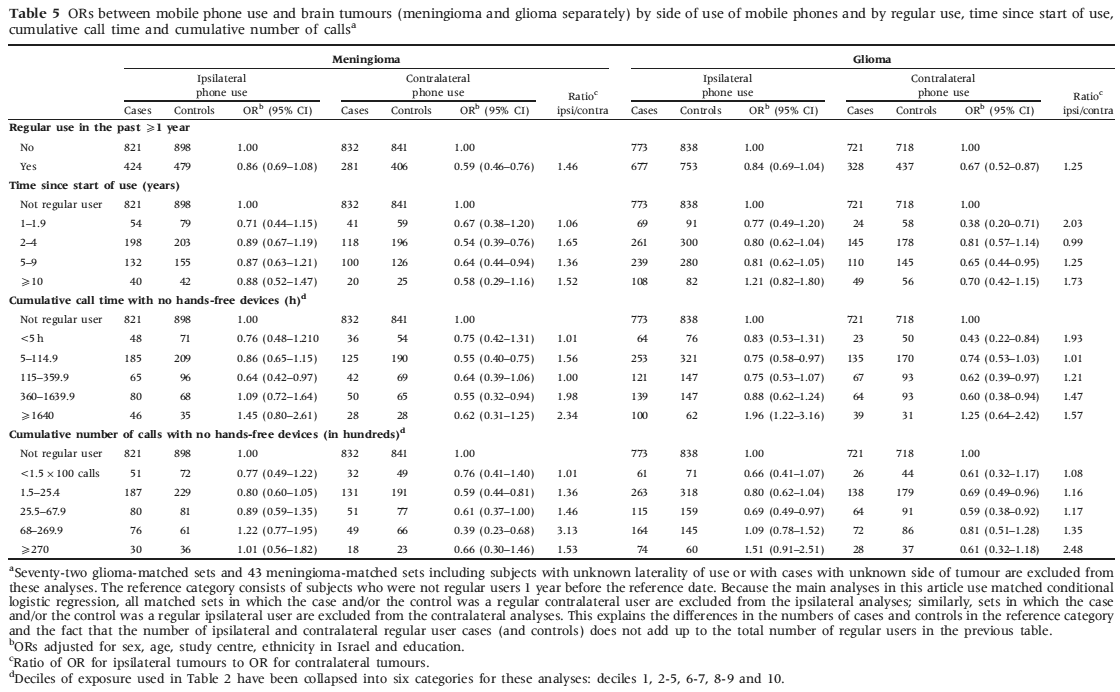
The true control here is the side of the head of the tumor: same side as phone use or opposite side. If that is the test, the data from the study are scary. Clearly tumors are more likely on the "same" side, at whatever astronomical p value you want to use. That cannot be explained away by misremembering, since an auxiliary study showed misremembering was not biased toward cell phone-tumor consistency.
A strong signal in the data pointed by Prof. Erikson is that the tumors are overwhelmingly likelier to appear on the same side of the head as where the phone is held. I've converted the ratios into percentages, based on an assumption that the risk for tumors would be apriori equal for both sides of the head.
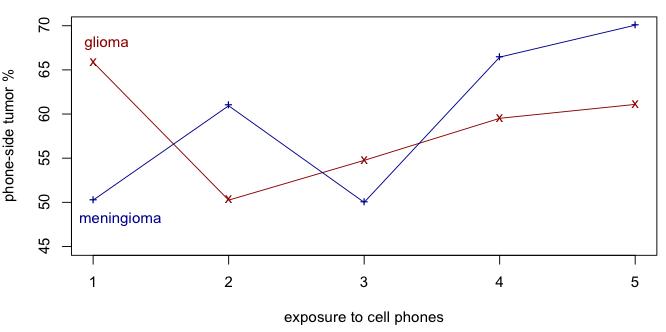
There is a group of people with low-to-moderate exposure and high lateral bias, but the bias does increase quite smoothly with increasing exposure. It's never below 50%.
But even with something apparently simple like handedness, there are possible confounding factors. For example, left-handed and ambidextrous people have a lower risk of brain cancer, perhaps because they zap their brain with cell phones more evenly across both sides, reducing the risk that a single DNA strand will be zapped one too many times, but they also earn more. I've written about handling multiple potential causes at the same time a few years ago.
The authors also point out that people might be inclined to blame it all on the phones and to report phone use on the side where the tumor was identified. This could be resolved if the controls are led to think that they have a tumor too, or if instead of asking how the phone is held, the interviewers instead made a call and observed the subject, or asked about a value neutral attribute such as handedness. Still, even in papers that reject the influence of phones on brain tumors, it's always the case that more tumors are on the right side, just as we know that more people are right-handed than left-handed.
In the light of this investigation, I fully agree with Prof. Erikson that there is something going on.
The table in question is here:







Pretty sure I'd rather rearrange my schedule for a bogus prospective student, than deal with having me or a loved one "led to think I [or they] have a tumor."
Good science has its costs. You have to balance the risks between perplexed and scared subjects, people not wanting to use a cell phone when they could save someone's life, and subjects dying of a brain tumor.
Were brain tumours more prevalent on the right side prior to cell phones?
And what else do people do more with their right hand than their left?
Are sinister people more likely to come to no good and hence not be available for diagnosis?
I do remember a clinician I knew initially getting very excited about this idea about 15 years ago - and then not so excited ;-)
If we could randomize people to accept to use cell phones that only work on the right versus left ear (randomly assigned) we would get a credible answer...
K?
How strong is the link between handedness and where you hold a phone?
I am right-handed and will use my right hand for things that require more dexterity. So if I am doing nothing else and I pull out my phone and dial one-handed, it will be in my right hand.
But if I am clicking through my address book, or doing some non-voice task on my phone (especially a smartphone) before or during the call, I will tend to hold the phone in my left hand and work with my right, so when it goes to my ear it's in my left hand.
Holding a phone to my ear takes very little manual dexterity, so if I do anything else while on the phone -- thumb through a book, jot down a note, click a mouse, put on my glasses, carry something, etc -- I will have the phone in my left hand and will use my right hand where dexterity (or strength) is needed.
That's not even counting my habit of switching the phone from ear to ear during longer conversations, to avoid too much exposure to one side. And, in a Seth-like observation, I often feel a tingly sensation on one side of my head when a cellphone is there very long, and never on the other, so I'd tend to favor the other side regardless of handedness.
My instinct is that most people use their strong hand to do tasks that require dexterity or strength, neither of which are required to simply hold a phone, so it all boils down to dialing and other tasks performed while holding the phone.
The real factor you want to control for is hearing, because many people will use the phone on their better ear, which does not necessarily correspond to the side of their dominant hand.
> This could be resolved if the controls are led to think that they have a tumor too ...
Not really an option in the aftermath of the Milgram experiment, the Stanford prison experiment, the Monster experiment, etc. due to modern human subject ethical research restrictions.
Is there data on what hand people hold their phone (landline or cell) in? Then, can we compare tumor prevalence differentials among those who use cell phones and those who don't? ...or model it as a function of reported hours of cell phone use per week or something like that?
Would seem to be a decent way of determining if it's "handedness" affecting tumor risk or if it's actual cell phones.
Wayne is exactly right. I have no idea which side I use more, since I would default to my right but use my left if I am doing something else, and I switch sides frequently. And is there a difference if I hold it against my ear or perch it on my shoulder? My cell phone is loud enough for me not to hold it against my head, so I will sometimes talk with it directly in front of me, held like a two-way radio (or old Star Trek communicator).
But I might just be weird.