NY Times published an awful article 25th Anniversary Mark Elusive for Many Couples that deserves a comment. Here is a quote:
Among men over 15, the percentage who have never been married was 45 percent for blacks, 39 percent for Hispanics, 33 percent for Asians and 28 percent for whites.Among women over 15, it was 44 percent for blacks, 30 percent for Hispanics, 23 percent for Asians and 22 percent for whites.
No wonder! The median age for whites in the US in 2000 was 37.7, for Asians 32.7, for blacks 30.2 and for Hispanics 25.8. 11 years of age difference should make a difference when it comes to the probability of having been married, no?
While they didn't control for age here, they did unnecessarily control for sex in this highly uninformative table-of-many-numbers:
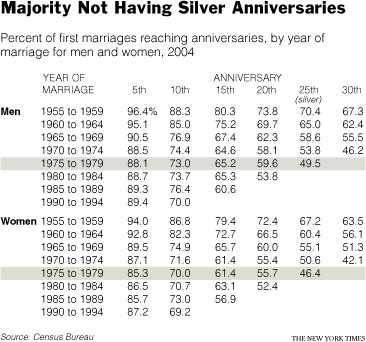
The gross JPEG artifacts that blur the fonts are theirs, not mine: they should have known to use PNG or GIF for figures with lots of text. Does anyone gain any insight from the difference between women and men's probability other than noise? A similar nonsensical control appeared in Men with younger women have more children where the difference in optimum age difference between men (6) and women (4) is purely a statistical artifact if you go and read the paper.
Yuck. I wouldn't have posted this if this hadn't made it to the 6th place of most emailed articles in past 24 hours.
In summary, when displaying the data control for things when 1) you need to remove a known effect, 2) controlling for things tells you something you didn't know before. And use graphs not tables! And educate journalists about the basics of statistics!




I don't know what insight to gain here, but the difference between women and men's probability is almost certainly not noise. Notice that the probability for women is strictly lower than that for men. Not sure what the exact cause there is--women marrying earlier in a growing population? Does anyone have an idea?
Drew, since values are associated with a generation (year of birth) more than with the year of marriage, and since women tend to be younger than men, the result is obvious. But I don't think the huge table displays this pattern very well.
And the article's main point is also far off check out this opinion piece which explains problems with the numbers