« NYC paintings | Main | Class divisions and social networks »
June 25, 2007
Animated MDS convergence
A few days ago we had quite a discussion on multidimensional scaling. While everyone agreed that initialization is important with non-convex problems, minimizing some objective function is more appealing than using initial placement for the prior, except in appealing circumstances such as iterative scaling. For the objective function approach, one can regularize the stress function, and it is also possible to use the prior to shrink towards geographic positions.
The untidy initial placement approach is sufficient, however, to provide a visualization as we travel from the initial placement towards the final placement. Namely, the clinal pattern in the final placement is only one of the things we can learn: the migrations of points and the resulting stresses are just as interesting in providing insight about the differences between the simple uniform geographic diffusion model and the real distribution of genes in Europe.
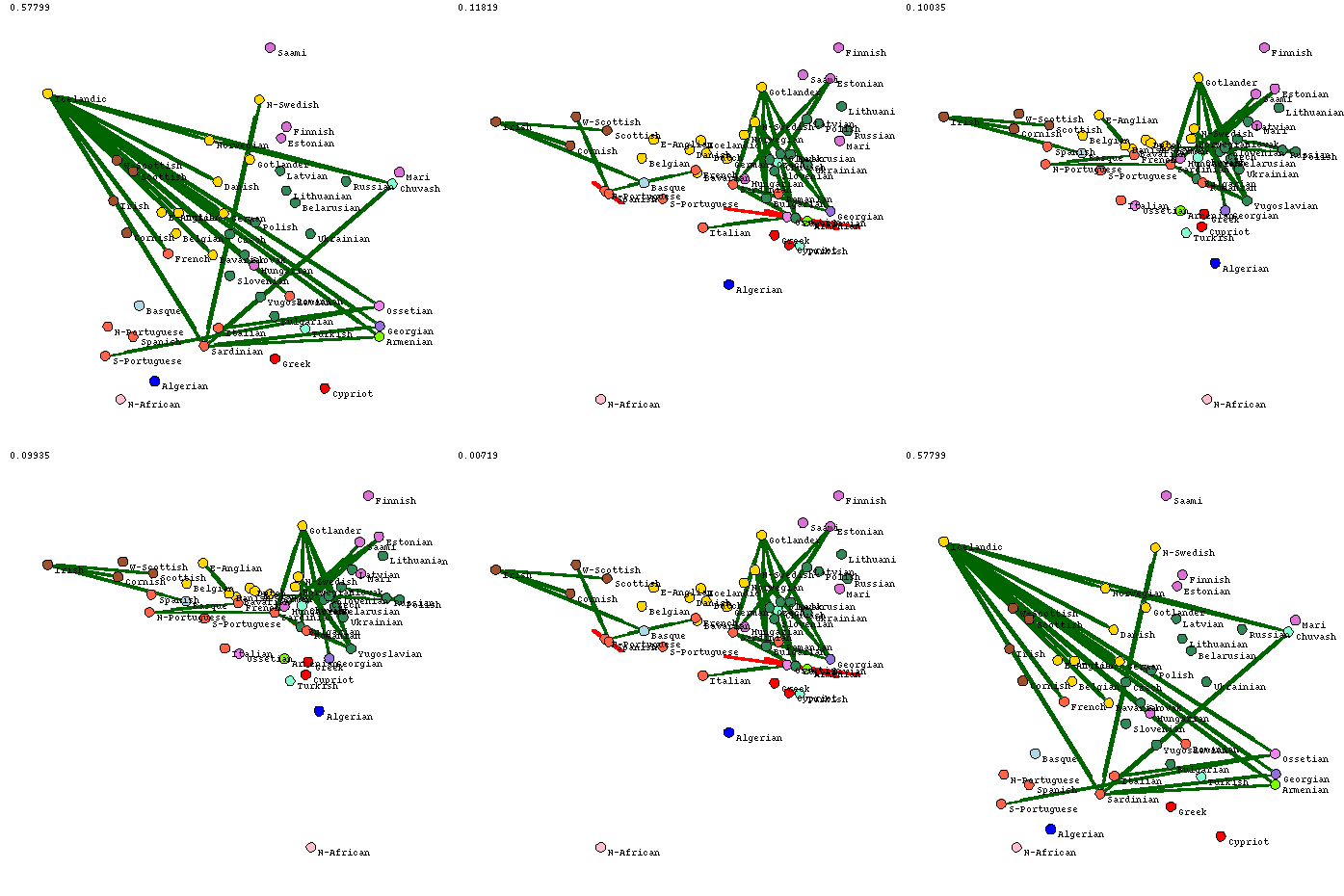
I also visualize the stress (at the top), and the strongest attraction/repulsion vectors.
The Python source code is now available if you agree to post a link to all derivative work in the comments of this entry, you can click here [ZIP]).
Posted by Aleks at June 25, 2007 6:10 PM

Trackback Pings
TrackBack URL for this entry:
http://www.stat.columbia.edu/~cook/movabletype/mt-tb.cgi/1011
Comments
Also see ggvis (part of ggobi, http://ggobi.org) where you can also interact to help it get out of local minima.
Posted by: Hadley at June 27, 2007 3:41 PM.
Posted by: Aleks ![[TypeKey Profile Page]](../assets/877f66dc64771560.gif) at June 27, 2007 5:04 PM.
at June 27, 2007 5:04 PM.
Posted by: Hadley at June 28, 2007 9:43 AM.
Yes. The MDS implementation doesn't really care about the dimensionality. I exported the points into VRML for 3D viewing, and if you add the motion, it will be 4D.
Posted by: Aleks at June 28, 2007 12:18 PM.