« Pseudo-failures to replicate | Main | Cougar, cougar, burning bright/ In the canyons of the night »
April 2, 2007
Range voting
I have come across the Range Voting website. The basic idea is to allow voters to express their preferences on a scale from 0-100. The winner is then that one candidate that has least Bayesian regret, or the highest average score.
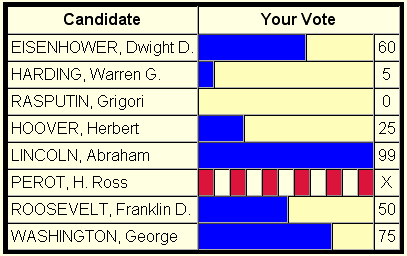
I guess this system would make it harder for radical candidates to win, and it would give an edge to those that would try to address everyone (although polarized voters would still only use 100 or 0). It might even have a lower cognitive cost in voting, as it doesn't require the voter to make the choice, but merely to assign grades to those candidates one is familiar with.
The website has a good collection of descriptions of other voting models, I've enjoyed this voting-with-money scheme. For those that want to dig deeper, there is a very good system of pages on Wikipedia.
Posted by Aleks at April 2, 2007 9:51 AM

Trackback Pings
TrackBack URL for this entry:
http://www.stat.columbia.edu/~cook/movabletype/mt-tb.cgi/896
Comments
Thanks for posting this. I have argued with my colleagues for years that in a winner-take-all election between two candidates, only 1 vote counts and all other votes (no matter how many there are or how large the margin of victory) are irrelevant. This voting scheme appears to give at least some relevance to every vote.
KW
Posted by: K Wright at April 2, 2007 11:37 AM.
It does have the problem of requiring cardinal valued preferences. Sure you can put 100% on the ones you like and %0 on the ones you don't, but then that's just approval voting, which has its own problems.
Posted by: OneEyedMan at April 2, 2007 7:38 PM.
Range Voting does "degrade" to Approval Voting if every voter is strategic, but that's fine because Approval is still the second best voting method, with Range being the first. And we know that well over half of Range Voting users will be honest, especially when it comes to fledgling and/or third party candidates, whom they do not perceive to have a real chance of winning anyway. This causes a "nursery effect", where fledglings get a little initial boost, until they are substantial enough to warrant strategy against them. See http://RangeVoting.org/NurseryEffect.html
I should note that having the highest utility efficiency (or lowest "Bayesian regret") is not the same thing as having the highest average score. It is possible for the winner of a Range Voting election to not be the social utility winner. The point is that on average, Range Voting produces a far greater voter satisfaction index (just a lay term for "social utility efficiency") than the other 60 or so voting methods it's been statistically compared to in extensive election simulations. That means that all voters should want Range Voting - because they'll be happier with it.
See http://RangeVoting.org/vsr.html
Clay Shentrup
San Francisco, CA
415.240.1973
http://reformthelp.org/issues/voting/range.php
Posted by: Clay Shentrup at April 2, 2007 9:04 PM.
Range voting suffers from serious deficiencies. Not least of them is the ability of a "strategic fringe" to "overrule the vast majority of voters." FairVote has put together an interesting evaluation of range and other single-winner methods. See my URL.
Posted by: JS at April 18, 2007 3:27 PM.